
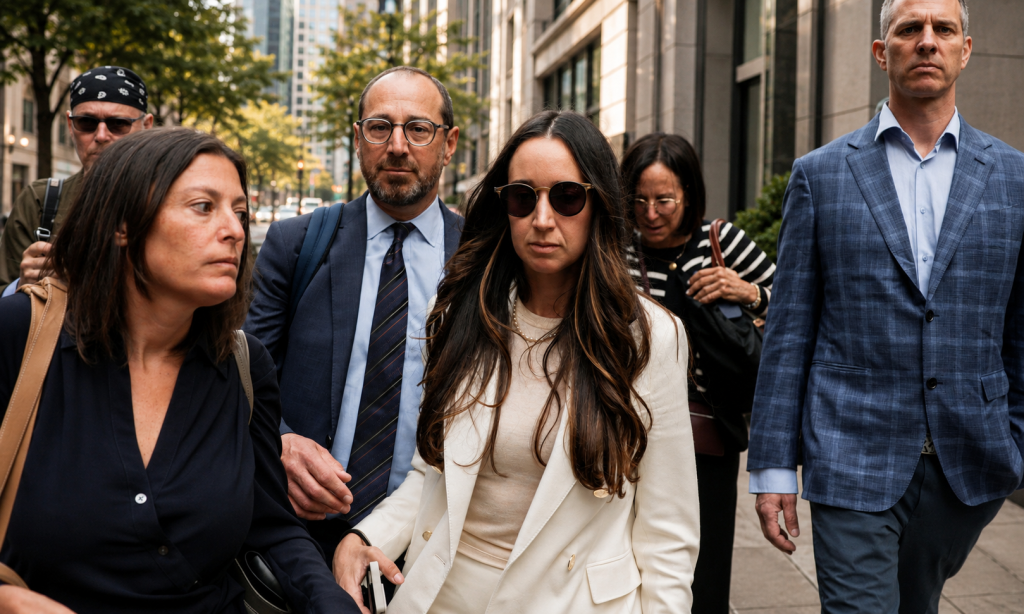
Charlie Javice became one of the most talked-about startup founders in America after her financial aid company, Frank, went from a celebrated fintech success story to the center of a major fraud case involving JPMorgan Chase. Her name is now searched by people trying to understand who she is, what Frank did, why JPMorgan bought the company, and how a startup once promoted as a helpful tool for students ended in criminal conviction and prison sentencing.
The Charlie Javice story is not just about one entrepreneur. It is also about startup culture, investor pressure, due diligence, financial technology, and the risks of building a company around impressive-looking user numbers. At its peak, Frank was presented as a platform helping students navigate financial aid. By 2025, Javice had been convicted of conspiracy, wire fraud, bank fraud, and securities fraud after prosecutors said she dramatically inflated Frank’s customer base during the company’s sale to JPMorgan Chase.
Who Is Charlie Javice?
Charlie Javice is an American and French entrepreneur best known as the founder of Frank, a startup designed to help students and families with the financial aid process. She studied at the University of Pennsylvania’s Wharton School and built a public image as a young founder working on a real problem: the confusing, stressful, and paperwork-heavy process of applying for college financial aid.
Before the legal case, Javice was often described as an ambitious fintech founder. Frank’s mission sounded practical and appealing because millions of students in the United States deal with the Free Application for Federal Student Aid, commonly known as FAFSA. The idea behind Frank was to make that process easier, faster, and more accessible for families who needed help understanding financial aid options.
That mission helped Javice gain attention in the startup world. She was included in Forbes’ “30 Under 30” list in 2019, a recognition that often brings credibility to young founders. For a while, Frank seemed like the kind of company that fit perfectly into the fintech boom: a digital platform, a large student market, and a clear promise to simplify a complicated financial process.
What Was Frank?
Frank was a student financial aid startup that aimed to help users complete financial aid forms and understand college funding options. The company positioned itself as a simpler way for students to access aid, reduce confusion, and manage the early financial steps of higher education.
The appeal was easy to understand. College is expensive, financial aid rules can feel complicated, and many students do not know how much support they may qualify for. A platform that could make the process smoother had a strong market angle. This is one reason Frank attracted attention from both users and large financial institutions.
JPMorgan Chase saw potential value in Frank because the bank wanted access to younger customers and the student finance market. A startup with millions of student users would have been attractive to a major bank looking to build long-term relationships with future borrowers, savers, and financial product users. According to the SEC, JPMorgan believed Frank had access to data on 4.25 million students, while the real number was far lower.
The $175 Million JPMorgan Deal
In 2021, JPMorgan Chase bought Frank for $175 million. On paper, the deal looked like a strategic move. JPMorgan could gain a student-focused fintech brand, expand its reach among younger consumers, and use Frank’s user base to market financial products.
For Javice, the acquisition represented a major founder success story. Selling a startup for $175 million is the kind of exit that many entrepreneurs dream about. It can turn a founder into a major name in business and make the company appear validated by one of the world’s most powerful banks.
But the deal quickly became controversial. JPMorgan later accused Javice of misrepresenting Frank’s user numbers. Prosecutors said Frank had about 300,000 real users, while Javice represented that the company had 4.25 million. That gap became the center of the criminal case.
What Went Wrong?
The core issue in the Charlie Javice case was user data. In startup acquisitions, numbers matter. Buyers look at revenue, growth, engagement, customer lists, technology, and market potential. If a company claims millions of users, that can dramatically affect its valuation.
According to the SEC’s complaint, Javice allegedly tried to make JPMorgan believe Frank had access to millions of student customers. The SEC said that when JPMorgan asked to review the customer data, Javice sought help creating synthetic data after an engineering employee refused to generate fake customer information. The SEC also alleged that she later paid a data science professor to create data needed to close the transaction.
This part of the case became especially important because it touched on trust in startup deals. Acquirers often depend on company-provided information during due diligence. If those numbers are false, the buyer may be paying for a business that does not actually exist at the scale promised.
The Criminal Charges Against Charlie Javice
In April 2023, Charlie Javice was charged by federal prosecutors and also faced civil charges from the SEC. The case focused on whether she knowingly misled JPMorgan Chase about Frank’s customer base during the acquisition process.
The criminal case moved through federal court in Manhattan. Javice pleaded not guilty, but after a six-week trial, she and former Frank executive Olivier Amar were convicted in March 2025. The convictions included conspiracy, wire fraud, bank fraud, and securities fraud.
For many observers, the case became another example of a larger question in tech: how far can founders go when selling a vision? Startups often rely on ambitious projections and aggressive growth stories. But the Javice case showed the legal line between optimistic startup storytelling and fraud. A founder can talk about potential, but customer numbers, user data, and acquisition materials must be truthful.
Charlie Javice Sentencing
In September 2025, Charlie Javice was sentenced to 85 months in prison for the $175 million fraud. The sentence was imposed by U.S. District Judge Alvin K. Hellerstein. Prosecutors said she repeatedly lied about Frank’s success and hired outside help to create data supporting those false claims.
The sentence made the case even more widely discussed because Javice had once represented the promise of young startup success. Her path from celebrated founder to convicted executive became a cautionary story for entrepreneurs, investors, banks, and anyone involved in startup acquisitions.
Javice has continued to fight the conviction. In March 2026, a federal judge rejected her request to overturn the conviction based on alleged conflicts involving law clerks who had accepted jobs with JPMorgan’s outside law firm. Reuters reported that the judge said the clerks’ roles did not create an appearance of bias and that the evidence against Javice was strong.
What Happened to Olivier Amar?
Olivier Amar, Frank’s former chief growth officer, was also part of the case. He was convicted alongside Javice and later sentenced to 68 months in prison for his role in the fraud. Reuters reported that Amar was involved in the same scheme related to misleading JPMorgan about Frank’s user base.
His sentencing showed that the case was not treated as a one-person issue. Prosecutors argued that the fake user data and acquisition misrepresentations involved more than one executive. This reinforced one of the biggest lessons from the Frank case: company leadership can face serious consequences when acquisition materials are manipulated or knowingly false.
Why the Charlie Javice Case Became So Famous
The Charlie Javice case attracted attention for several reasons. First, the money involved was large. A $175 million acquisition by JPMorgan Chase is not a small startup deal. Second, the alleged difference between the claimed and actual user numbers was huge. Claiming 4.25 million users when the real number was around 300,000 created a dramatic and easy-to-understand story.
Third, the case involved a founder who had been publicly celebrated. When someone appears on high-profile young entrepreneur lists and later faces criminal conviction, the story naturally draws attention. It raises uncomfortable questions about how startup success is judged and how much the business world depends on image, confidence, and growth narratives.
Finally, the case involved JPMorgan itself. The bank is one of the biggest financial institutions in the world, so people questioned how such a large buyer could end up in a failed acquisition. Even Judge Hellerstein reportedly criticized JPMorgan’s due diligence while still emphasizing Javice’s fraudulent conduct.
Charlie Javice Net Worth: Why Claims Are Unclear
Many people search for Charlie Javice net worth, but reliable current estimates are difficult. Before the legal case, she received major financial benefits from the Frank sale, including stock proceeds and potential compensation connected to her JPMorgan role. The SEC said Javice received $9.7 million directly in stock proceeds, millions more indirectly through trusts, and a contract that included a $20 million retention bonus.
However, those figures do not equal current net worth. Legal fees, forfeiture, restitution orders, appeals, and asset restrictions can all change the picture. Because of that, any simple online estimate of Charlie Javice’s net worth should be treated carefully unless it is based on verified court records.
What Startups Can Learn From the Frank Case
The Charlie Javice story is now used as a warning in the startup world. Growth numbers may help raise money, attract buyers, and build media attention, but they must be real. User data, customer lists, revenue metrics, and engagement statistics are not marketing slogans. They are business facts.
For founders, the lesson is clear: never inflate metrics to close a deal. A startup can survive slow growth, a difficult market, or a failed sale. It may not survive fabricated data. For investors and buyers, the lesson is also clear: due diligence cannot rely only on founder confidence or polished pitch materials. Large companies must verify customer data, test assumptions, and examine the quality of a startup’s numbers before closing a transaction.
The case also says something about startup culture. The pressure to grow quickly can tempt founders to present the company as bigger than it is. But once false numbers enter investor decks, acquisition talks, or financial documents, the risk becomes legal, not just reputational.
Why People Still Search Charlie Javice
People continue to search Charlie Javice because her story sits at the intersection of business, money, ambition, and downfall. It has the elements of a modern startup drama: a young founder, a promising fintech idea, a major bank, a massive acquisition, fake user data claims, a criminal trial, and a prison sentence.