

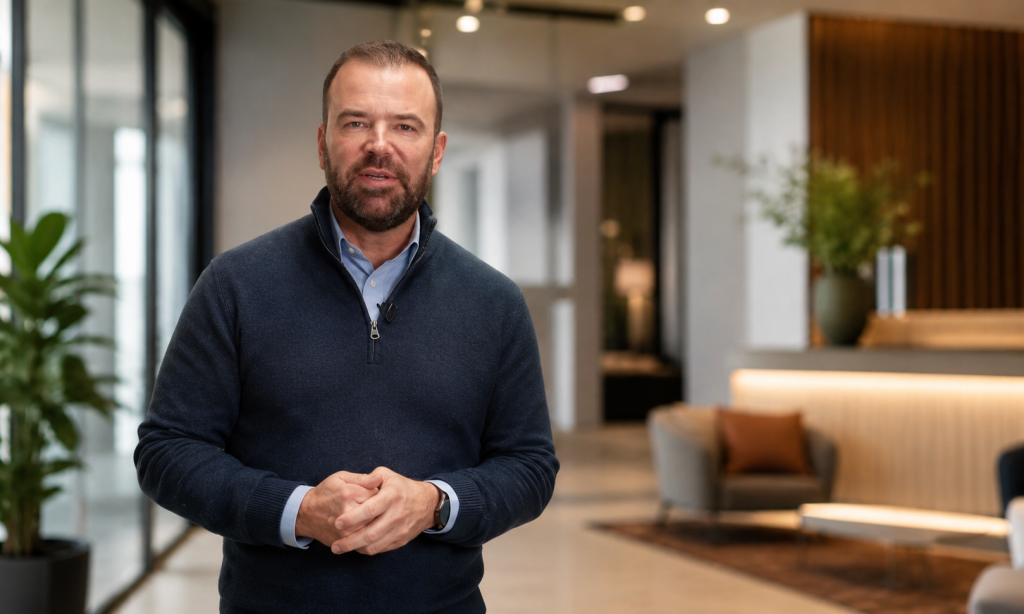
The M&S chief executive is Stuart Machin, the retail leader responsible for guiding one of Britain’s most familiar high street names through a major period of change. Marks & Spencer, often shortened to M&S, is not just another retailer. For many UK shoppers, it is linked with food halls, school uniforms, underwear, workwear, Christmas ranges, home products and a certain level of everyday quality.
That makes the role of Marks & Spencer chief executive more important than a standard corporate title. Whoever leads M&S has to protect the brand’s long-standing reputation while also making it feel modern, sharper and more relevant to younger shoppers. Stuart Machin has become closely associated with that challenge.
Who Is the M&S Chief Executive?
The current M&S chief executive is Stuart Machin. He became Chief Executive Officer in May 2022 after already holding senior roles inside the business, including Joint Chief Operating Officer and Managing Director of the Food division.
Before joining Marks & Spencer, Machin built a long career in retail across the UK and overseas. His background includes senior roles at major names such as Sainsbury’s, Tesco, Asda, Coles and Target department stores in Australia. This mix of food, fashion, home and operational experience is one reason his appointment was seen as a practical choice for a business that needed both commercial discipline and stronger execution.
At M&S, the job is not only about boardroom strategy. The company has several moving parts: M&S Food, Clothing, Home & Beauty, store modernisation, digital growth, supply chain improvements, online shopping and brand perception. The chief executive has to keep all of these areas moving in the same direction.
Why Stuart Machin Matters to M&S
Stuart Machin matters because M&S has spent years trying to prove that it can be more than a nostalgic British retailer. The company has always had strong brand recognition, but brand recognition alone is not enough in modern retail. Customers now expect better value, cleaner store layouts, stronger digital service, faster delivery, stylish clothing ranges and consistent food innovation.
Under Machin’s leadership, M&S has focused heavily on what many observers call a turnaround. That means improving the parts of the business that were underperforming, modernising stores, sharpening product ranges and making the brand more appealing without losing its core identity.
For shoppers, this shift can be seen in several ways. Food ranges have become more innovative and more central to the brand’s growth story. Clothing has also tried to move away from old-fashioned perceptions by offering better fits, stronger basics, more stylish seasonal ranges and improved marketing.
For investors, the M&S CEO is important because the company’s performance depends on whether this transformation can continue. Retail is a difficult sector. Costs rise, consumer confidence changes, online competition is intense and customer loyalty cannot be taken for granted.
Stuart Machin’s Leadership Style
The M&S chief executive Stuart Machin is often described as hands-on, detail-focused and highly involved in the day-to-day running of the business. That style fits the kind of company M&S is. It is a retailer where small details matter: food quality, store availability, clothing fit, pricing, display standards, delivery performance and customer experience.
A hands-on retail leader usually spends less time talking in abstract business language and more time looking at what customers actually see. Are the shelves full? Are the ranges clear? Is the online experience smooth? Are stores easy to shop? Are products worth the price? These practical questions sit at the heart of Machin’s approach.
This matters because Marks & Spencer is not a purely digital brand or a luxury fashion house. It is a mainstream retailer with millions of regular customers. A strong strategy only works if it improves the shopping experience in real life.
M&S Food and the CEO’s Influence
One of the most important parts of Stuart Machin’s story is his connection with M&S Food. Before becoming chief executive, he served as Managing Director of the Food business. That gave him direct experience in one of the company’s strongest and most loved divisions.
M&S Food is a major part of the brand’s appeal. Customers often associate it with ready meals, fresh produce, premium treats, seasonal food, quality ingredients and lunch options. However, food retail is also competitive. Supermarkets, discounters and convenience chains all fight for the same customer spend.
Machin’s food background gives him a strong understanding of product innovation, supplier relationships, store execution and value perception. For M&S, this is useful because food often brings shoppers into stores more regularly than clothing or homeware. A strong food business can support footfall, strengthen customer loyalty and help the wider brand feel active and relevant.
Clothing, Home and Beauty: A Big Test for the M&S Boss
While food has often been one of M&S’s strengths, clothing has historically been more complicated. For years, Marks & Spencer faced criticism that some fashion ranges felt too safe, too inconsistent or not stylish enough for younger customers. That made Clothing, Home & Beauty a key test for the M&S boss.
Under the current leadership, M&S has worked to improve product style, fit, availability and brand appeal. The goal is not to turn M&S into a trend-only fashion retailer. Instead, the brand needs to offer dependable wardrobe pieces with enough freshness to attract modern shoppers.
This is where basics matter. Underwear, knitwear, denim, coats, workwear, activewear and everyday dresses are all areas where M&S can win if the quality, fit and price feel right. Beauty is also an interesting growth area because customers already trust M&S stores and may be open to discovering skincare, fragrance and personal care products there.
Digital Growth and Modern Retail Challenges
Another major responsibility for the M&S chief executive is digital transformation. Retail today is no longer divided neatly between stores and online. Customers may browse on a phone, check stock online, visit a store, use click and collect, return items through another channel and expect the whole process to feel connected.
That creates pressure on technology, logistics, customer service and stock management. A retailer like M&S must serve traditional store customers while also meeting the expectations of online shoppers. This is especially challenging because clothing, food and home products all have different supply chain needs.
M&S has also had to deal with disruption linked to digital systems and online operations. In its half-year update for the period ended 27 September 2025, M&S said results were affected by a cyber incident, with lower online sales, recovery costs and disruption across parts of the business. Food sales still rose during that period, while Fashion, Home & Beauty was more heavily affected by the pause and recovery of online operations.
For any modern retailer, this highlights a simple reality: technology is now central to trading. It is not just an IT department issue. It affects sales, stock flow, customer trust and profit.
The Turnaround Story at Marks & Spencer
The phrase “turnaround” is often used when discussing Stuart Machin M&S leadership. In plain English, it means taking a business that had lost some momentum and making it stronger, clearer and more competitive again.
M&S reported strong full-year progress for the 52 weeks ended 29 March 2025, including higher adjusted profit before tax and growth in Food and Fashion, Home & Beauty sales. Food sales reached £9.0bn, while Fashion, Home & Beauty sales rose to £4.2bn for that year.
Those figures matter because they show why Machin’s leadership has received attention. M&S was not simply trying to survive; it was trying to grow again and improve its reputation with customers and investors.
However, a turnaround is not a one-time event. It has to continue. The brand still faces competition from supermarkets, fashion retailers, online marketplaces, discounters and specialist beauty or home brands. The challenge for the Marks and Spencer CEO is to keep the business improving even when trading conditions are difficult.
What Makes the M&S CEO Role Difficult?
The M&S chief executive role is difficult because the brand has a wide customer base. Some shoppers want M&S to stay traditional. Others want it to become more modern. Some visit mainly for food. Others care about clothing, underwear, homeware or beauty. Some customers are price-sensitive, while others are willing to pay more for quality.
Balancing these expectations is not easy. If M&S becomes too trendy, it may lose loyal older customers. If it becomes too cautious, it may fail to attract younger shoppers. If it focuses too much on premium ranges, it risks looking expensive. If it focuses too much on value, it may weaken the quality image that makes the brand special.
That is why leadership at M&S requires careful judgement. The CEO has to modernise the business without stripping away the trust that made it famous.
Stuart Machin’s Retail Background
Stuart Machin’s long retail background is one of his biggest strengths. He has worked across food, general merchandise, fashion and home retail. He has also operated in different markets, including the UK and Australia.
This matters because M&S is not a single-category business. A CEO with only fashion experience might struggle with food. A leader with only supermarket experience might not fully understand style-led clothing. Machin’s career gives him a broader view of how stores, supply chains, product teams and customer habits connect.
His background also suggests a practical understanding of retail operations. In a business like M&S, operations are not boring back-office details. They shape whether customers find the product they want, whether shelves look attractive, whether online orders arrive correctly and whether stores feel enjoyable to shop.
Public Interest in the M&S Chief Executive
Searches for m&s chief executive often increase when the company is in the news. People may want to know who runs M&S after a financial update, a cyber incident, a store announcement, a leadership change or a major business decision.
There is also public interest because M&S is part of everyday British life. When the company performs well, struggles, closes stores, opens new locations or changes its ranges, many customers notice. The CEO becomes the person people associate with those decisions.
For business readers, Stuart Machin is important because he represents one of the more closely watched UK retail leadership stories. For everyday shoppers, he matters because his decisions influence the products, prices, stores and services they experience.
How the M&S Chief Executive Is Shaping the Brand
The current M&S chief executive is shaping the brand around a few clear priorities: better products, stronger stores, food growth, clothing improvement, digital progress and operational discipline. The aim is to make M&S feel more modern while keeping the quality and trust that customers expect.